
Journal
How to Stack Sculptural Rings: Scale, Negative Space, and Mixed-Metal Rhythm
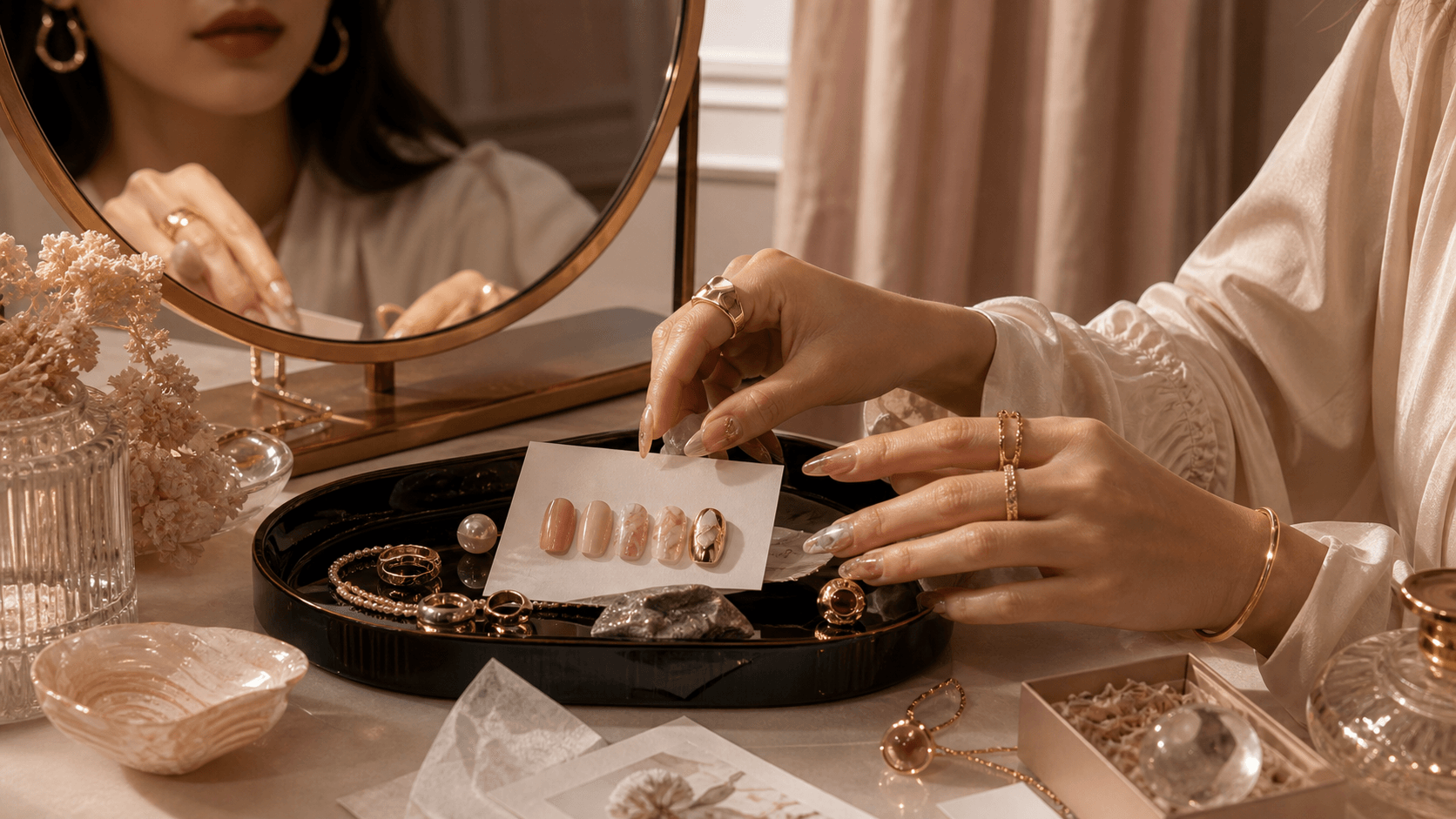

On a late train platform, a hand closes around a steel rail: one broad silver ring catches the fluorescent strip above, a narrow gold band interrupts it, and an open curve leaves a clean slice of skin between them. The stack works before you identify any individual piece. It has weight, pause, direction, and enough room to move. Learning how to stack sculptural rings is less about collecting more pieces than composing a small architecture for a moving hand. This guide shows how to control scale, negative space, mixed-metal rhythm, gemstone spacing, linked bands, cross-finger placement, fit, and comfort—without imposing a fixed ring count.

How to Stack Sculptural Rings by Building a Silhouette
Begin with the outline your hand creates from a distance. A successful stack should read as a deliberate silhouette before its details become visible. Place your hand naturally at your side, then look at it in a mirror rather than studying it flat on a table. Which ring projects outward? Where does the eye stop? Which fingers remain visually quiet?
Use an anchor–echo–air trio:
- Anchor: the ring with the strongest mass, height, width, stone, or directional shape.
- Echo: a second element that repeats one property of the anchor—its metal tone, curve, edge, finish, or line—without copying the whole design.
- Air: visible skin around and between forms, allowing each piece to keep its contour.
This is a composition formula, not a required number of rings. One articulated ring can contain its own anchor and echo. Four narrow bands can behave as one visual mass. A single ring on the opposite hand may provide the air and counterweight the composition needs. The result is a sculptural ring stack with hierarchy rather than clutter—the foundation of effective statement ring styling.
When browsing a sculptural ring collection, compare pieces by profile as well as front view. A ring that looks restrained from above may rise high from the finger; another may be broad but sit close to the skin. Projection changes the silhouette, the likelihood of catching on fabric, and the amount of space neighboring rings need.
Create Thick–Thin Rhythm Without Visual Traffic
Thickness is not only band width. It includes the apparent density of a ring: a hollow cage can occupy a large area while still feeling lighter than a compact signet. A translucent stone can appear quieter than a polished metal dome of the same dimensions. Judge visual weight by what the eye experiences, not by measurements alone.
A reliable rhythm begins with contrast. Place a broad plane beside a fine line, or a dense ring opposite an open construction. When every band has the same width and finish, the stack can flatten into one block. When every ring competes through scale, texture, stone, and height at once, the hand loses hierarchy.
For a mixed metal ring stack, treat color as a repeated structural note rather than a rule about matching. Gold can appear once as a narrow bridge inside a mostly silver arrangement; silver can return as a cool edge beside warmer rings. Repetition makes contrast feel intentional, but the repetition does not have to be symmetrical. A polished finish can also bridge two metals when their colors differ, while a shared brushed finish can make different alloys feel related.
Material names matter because color alone does not tell you what a ring is made from or how its surface may wear. The U.S. Federal Trade Commission’s Jewelry Guides state that sellers should represent metallic content, treatments, quality, and other material characteristics truthfully. Before building a stack intended for frequent wear, read the product description rather than assuming that “gold,” “silver,” or “mixed metal” describes the full construction. Switchroom’s materials guide and its discussion of how material and construction shape jewelry quality can help you compare those details.
Place Linked Bands and Gemstones as Moving Architecture
A linked-band ring is already a kinetic stack. Its parts may rotate, spread, overlap, or settle differently every time the hand moves. Treat the whole mechanism as a single piece before adding neighboring rings. If another piece is placed too close, the linked bands may lose their intended range of motion or repeatedly strike a raised setting.
Test linked rings in three states: fingers extended, hand relaxed, and hand lightly closed. Watch where the bands migrate. A ring that looks airy when posed may compress into a dense knot when the fingers bend. If its moving components naturally cross a knuckle crease or adjacent finger, give it more lateral space rather than forcing it into a crowded row.
Gemstones need both visual and physical clearance. A stone can function as a focal point, a flash of color, or a small interruption in an otherwise metallic order. Avoid placing several raised stones at identical heights across neighboring fingers unless the repeated skyline is intentional. Staggering their heights or separating them with a plain band usually creates a more legible rhythm.
Durability is more complex than scratch resistance. GIA explains that gemstone durability involves hardness, toughness, and stability; a hard stone may still be vulnerable to chipping or fracture from impact. GIA also warns that ultrasonic vibration can loosen stones or chip gems whose edges touch. For a gemstone stack, check whether settings, girdles, or sharp metal edges knock together during ordinary movement. When two pieces repeatedly collide, restyle them on different fingers or ask a qualified jeweler to assess the settings.

Use Cross-Finger Placement, Movement, and Negative Space
Cross-finger placement changes the hand’s visual direction. An index-finger ring tends to enter a gesture first. A middle-finger ring occupies the central axis. A pinky ring acts like punctuation at the edge. A thumb ring is seen from changing angles and experiences different contact because the thumb opposes the fingers. These are compositional tendencies, not prescriptions; your hand shape, dominant hand, work, and movement patterns matter more than convention.
Instead of filling every available finger, map where the stack needs silence. A bare finger can separate two complicated mechanisms. A gap at the base of one finger can reveal the negative space inside an open ring. Leaving the opposite hand nearly empty can make one dense stack feel sharper rather than incomplete.
Use this gesture test before committing to a stack:
- Rest: let both hands hang naturally and check the overall silhouette.
- Flex: bend and straighten each finger; note pinching, spinning, or bands crossing creases.
- Grip: hold a phone, cup, bag handle, and pen to locate pressure points.
- Transit: slide the hand into a coat pocket and through a sleeve to identify snagging projections.
- Contact: listen and feel for repeated metal-to-metal or stone-to-metal impact.
- Edit: remove, relocate, or rotate the piece causing friction; do not preserve a composition that only works for a photograph.

The question “how many rings to wear” is therefore answered by function and form, not a universal maximum. The stack is finished when the silhouette is clear, the focal point remains readable, negative space survives, and the hand can still perform its day.
Buy, Fit, and Care for a Stack You Can Actually Wear
Fit must be evaluated ring by ring and again as a group. A wide band can feel tighter than a narrow band at the same nominal size, and open or elevated constructions can behave differently from a standard even-width ring. GIA’s ring-sizing benchmark distinguishes wide bands, tapered rings, convex interiors, and rings with open space above the finger because their engineering affects measurement and fit. For an expensive, wide, top-heavy, or unusual ring, professional sizing is more reliable than guessing from a thin ring you already own.
Before purchasing a ring for stacking, check five details:
- Construction: solid, hollow, open, linked, hinged, adjustable, or fixed.
- Dimensions: band width, top height, projection, and any part extending toward adjacent fingers.
- Material and finish: base metal, precious-metal content, plating or coating, texture, and care instructions.
- Stone information: gem identity, treatments if disclosed, setting type, and whether the edges are exposed.
- Wear context: desk work, travel, events, making, lifting, frequent handwashing, or other repeated movements.
Care for each ring according to its material and construction, not according to the toughest item in the stack. GIA’s jewelry-care guidance notes that chemicals can damage metals and gems, that some treated or organic materials should not go into ultrasonic cleaners, and that separate padded storage helps prevent scratching and impact. Remove rings before household cleaning or chlorinated swimming, follow the maker’s instructions, and avoid dropping an entire mixed-material stack into one cleaning bath.
Store sculptural rings so their highest points, stones, and sharp edges do not press against neighboring pieces. Linked rings may need to lie flat; top-heavy rings may be safer in individual padded slots. Inspect moving joints and settings periodically, especially when the stack produces audible contact.
Once the mechanical questions are solved, style can remain fluid. A dense silver hand for one day can become a sparse gold-and-resin arrangement the next. That flexibility is part of Switchroom’s broader idea of why one signature style can become limiting. Build a ring wardrobe with enough difference in scale and construction to make new compositions, then use the wider jewelry collection to echo the stack elsewhere without forcing every accessory to match.
Frequently Asked Questions
How many rings should you wear at once?
Wear as many rings as the composition and your movement can support. Stop when the focal point becomes unclear, negative space disappears, or the rings pinch, collide, spin excessively, or interfere with ordinary tasks.
Can you mix gold and silver sculptural rings?
Yes. Make the contrast intentional by repeating a metal tone, finish, curve, or edge somewhere in the stack. A shared visual property can connect different metals without requiring equal amounts of each.
Should wide sculptural rings be sized up?
Sometimes, but not automatically. Wide bands can fit more snugly, while open, tapered, convex, and top-heavy constructions behave differently. Use the maker’s sizing guidance or have the specific ring style professionally measured.
How do you stop stacked rings from scratching each other?
Separate rings with exposed stones, sharp edges, delicate coatings, or very different hardness levels. Check for collision while flexing and gripping, relocate pieces that strike each other, and store rings separately in padded slots or pouches.